 Eulerfinance
 liquidations depend on vault-specific LTV thresholds and transfer debt alongside collateral.
Eulerfinance liquidations in Euler V2 transfer selected debt to a liquidator when an account no longer meets its liquidation collateral requirement. Borrow LTV limits borrowing capacity; liquidation LTV determines the collateral weighting at the liquidation boundary. A liquidator receives collateral at a health-dependent discount, subject to the vault's cap. Crossing that boundary establishes eligibility, while configured cool-off rules and transaction checks can still prevent execution. The liability vault sets each collateral relationship's LTVs, the discount cap, and the cool-off duration.
Borrow LTV and Liquidation LTV
The liability vault applies borrowing and liquidation limits to each collateral relationship, so one token does not carry a universal Euler threshold. LTV means loan-to-value; liquidation LTV is commonly shortened to LLTV. Borrow LTV governs borrowing power, while LLTV governs collateral's contribution to the liquidation test. Where those parameters leave a gap, an existing position can exceed its borrowing capacity without yet qualifying for liquidation. Compare limits for the same collateral vault, liability vault, and network. A percentage from another market may describe a different risk relationship.
The distance between current debt and liquidation capacity matters alongside LLTV. A higher permitted ratio alone does not describe the position's remaining margin.
Health at the Liquidation Boundary
An indebted account's health expresses its collateral coverage as
health = risk-adjusted collateral value / liability value
.
A standard EVK account reaches the liquidation boundary when its risk-adjusted collateral value no longer exceeds its liability value.
EVK means Euler Vault Kit, the lending-vault framework. The liquidation calculation uses the account's enabled collateral and the liability vault's applicable settings.
Valuation Inputs
Collateral Prices and LTVs
The liability vault's configured oracle route supplies collateral values for the account check. Each accepted collateral relationship contributes under its applicable liquidation weighting. A falling collateral price can therefore reduce coverage without any withdrawal from the account. Changes to applicable risk parameters can also alter that coverage. With multiple collateral assets, their combined risk-adjusted contribution determines coverage. A single token price does not describe the whole account.
Debt Prices and Interest
Outstanding debt grows as borrower interest accrues under the liability vault's interest-rate model. That growth can reduce health even when token prices remain unchanged. A rise in the debt asset's value relative to collateral can also worsen coverage. Monitoring only the collateral price misses both effects. The liability calculation needs current debt amounts and the applicable oracle valuation.
Raw Values and Conditional Timing
A displayed health score of 1 may hide values on either side of the boundary because interfaces round numbers. Raw onchain values provide the relevant comparison. Transaction simulation can help assess an intended action against those values. A successful simulation does not ensure later execution, since intervening transactions, interest accrual, and oracle updates can change account state.
A configured liquidation cool-off delays execution until enough time has passed since the account's last successful status check. It does not establish a universal countdown beginning when health crosses the threshold. The selected vault's configured duration and the account's relevant status-check time determine whether that restriction still applies.
Health-Dependent Discounts
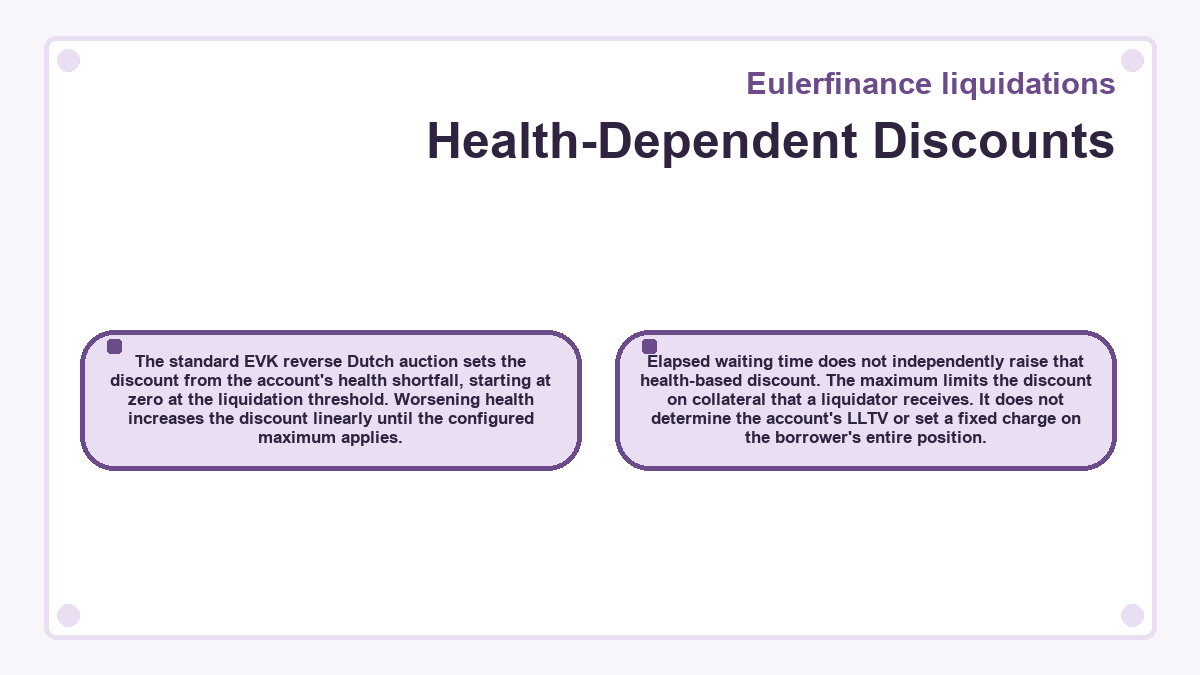
The standard EVK reverse Dutch auction sets the discount from the account's health shortfall, starting at zero at the liquidation threshold. Worsening health increases the discount linearly until the configured maximum applies. Elapsed waiting time does not independently raise that health-based discount. The maximum limits the discount on collateral that a liquidator receives. It does not determine the account's LLTV or set a fixed charge on the borrower's entire position.
Debt Takeover and Collateral Transfer
Standard EVK liquidation transfers selected debt and collateral to the liquidator in the same operation. The resulting liquidator account must pass its required checks. The liquidator must enable the liability vault as a controller and the received vault shares as collateral. The Ethereum Vault Connector (EVC) lets the enabled controller enforce the collateral transfer. The collateral vault recognizes that controller context during the transfer. Debt takeover itself does not require an upfront transfer of the debt token's full amount.
Receiving vault shares does not produce an immediate cash balance. Redeeming those shares depends on the collateral vault's available liquidity and account constraints.
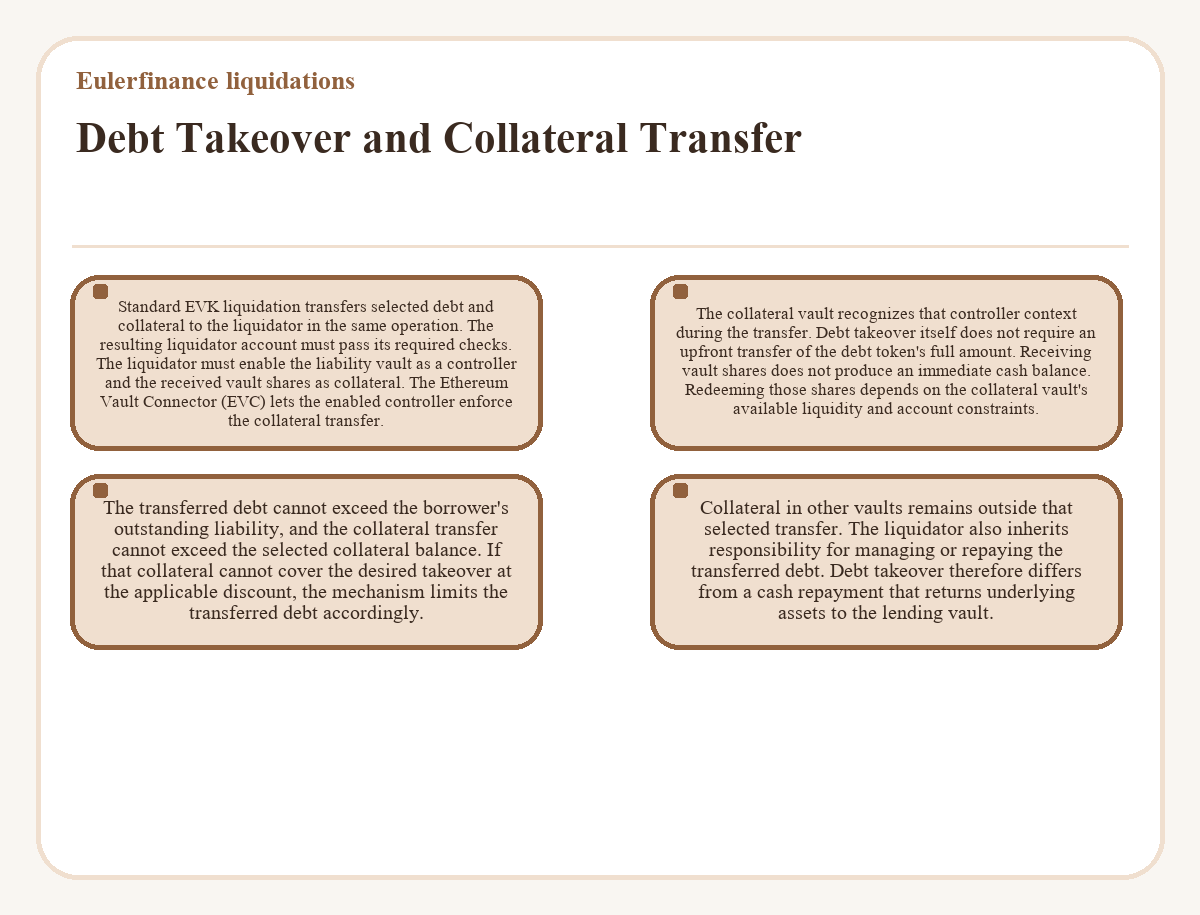
The transferred debt cannot exceed the borrower's outstanding liability, and the collateral transfer cannot exceed the selected collateral balance. If that collateral cannot cover the desired takeover at the applicable discount, the mechanism limits the transferred debt accordingly. Collateral in other vaults remains outside that selected transfer. The liquidator also inherits responsibility for managing or repaying the transferred debt. Debt takeover therefore differs from a cash repayment that returns underlying assets to the lending vault.
Execution Economics and Uncovered Debt
Market liquidity affects whether a liquidator can sell or hedge received collateral and manage inherited debt economically. Gas, slippage, and differences between oracle values and trading prices can consume the incentive. Thin liquidity can leave an eligible position unattractive to liquidators. If liquidation exhausts the account's collateral and qualifying debt remains, the vault can spread that loss across depositors only when its configuration enables that behavior and the contract's conditions hold.
Collateral Additions and Debt Repayment
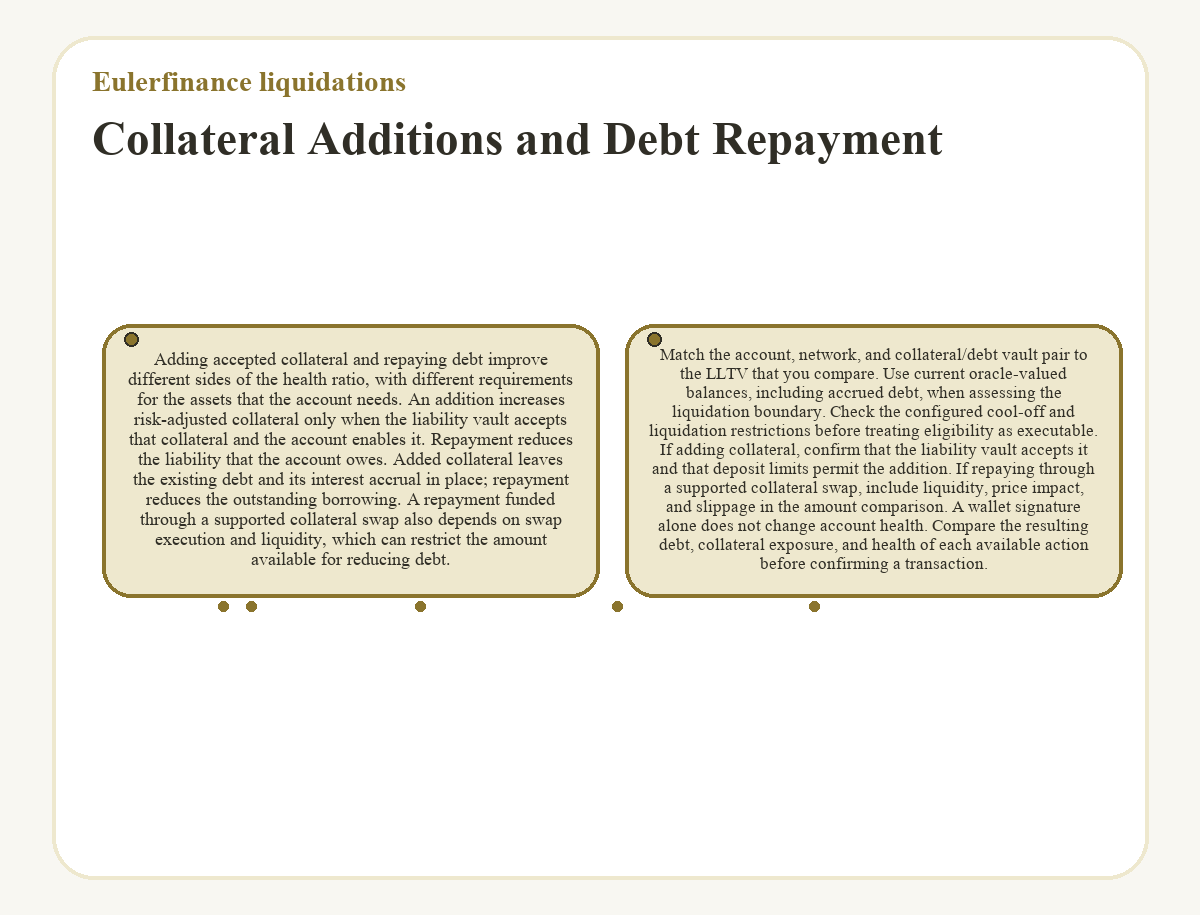
Adding accepted collateral and repaying debt improve different sides of the health ratio, with different requirements for the assets that the account needs. An addition increases risk-adjusted collateral only when the liability vault accepts that collateral and the account enables it. Repayment reduces the liability that the account owes. Added collateral leaves the existing debt and its interest accrual in place; repayment reduces the outstanding borrowing. A repayment funded through a supported collateral swap also depends on swap execution and liquidity, which can restrict the amount available for reducing debt.
- Match the account, network, and collateral/debt vault pair to the LLTV that you compare.
- Use current oracle-valued balances, including accrued debt, when assessing the liquidation boundary.
- Check the configured cool-off and liquidation restrictions before treating eligibility as executable.
- If adding collateral, confirm that the liability vault accepts it and that deposit limits permit the addition.
- If repaying through a supported collateral swap, include liquidity, price impact, and slippage in the amount comparison.
A wallet signature alone does not change account health. Compare the resulting debt, collateral exposure, and health of each available action before confirming a transaction.
Key questions about Eulerfinance liquidations
Can One Position Undergo Repeated Partial Liquidations?
A position can undergo further liquidation when its remaining collateral still fails the liquidation coverage test. A partial debt takeover also removes collateral, so it need not restore sufficient coverage. Current debt, collateral values, and the liability vault's rules determine whether another liquidation is possible.
Does EVC Lockdown Mode Stop Collateral Liquidation?
EVC Lockdown Mode still allows controllers to control collateral for affected accounts. The mode restricts other activity across the address prefix, with exceptions for managing operators and nonces. Those restrictions do not remove the liability controller's liquidation authority, so enabling lockdown does not shield an unhealthy borrowing position.
Do Finalized Vaults Keep Liquidation Exposure Unchanged?
Finalization removes the active vault governor's power over the parameters that it controlled, while liquidation exposure can continue changing. Oracle prices, interest accrual, and liquidity remain relevant. A separately governed oracle router or connected collateral vault can retain authority, and some deployments retain factory-level implementation upgrade authority.
Are Direct Lending Deposits Automatically Exposed to a Borrowing account's Liquidation?
A direct lending deposit does not automatically become collateral for an existing borrowing position. Liquidation authority concerns the enabled collateral of the affected EVC account under its controller's rules. The app generally separates Borrow and Multiply positions into sub-accounts, so a wallet-wide deposit total does not identify the collateral at risk.
How Can Configured Hooks Affect a Liquidation Attempt?
A configured hook can check, restrict, or block liquidation when that operation falls within its configured scope. Hook Targets contain the applicable logic, so a vault's liquidation conditions can include controls beyond the health calculation. The hook's deployed configuration determines which restrictions apply to the attempted operation.